
When was the last time you learned something genuinely new—and still remember it today? That question opened our presentation at LEARNTEC in Karlsruhe earlier this year. While many exhibitors focused on AI, we intentionally took a different angle: How can we use Actionbound to activate and train the human brain in ways that make learning stick? The reality is that we are surrounded by information, yet surprisingly little of it lasts. That is not a personal failure or a lack of motivation. It is a consequence of how the brain works. And that is exactly why brain-based learning matters.
Our brains prefer engaging content
Research has shown for decades that new knowledge fades quickly when it is not reinforced. Hermann Ebbinghaus's famous forgetting curve demonstrated that much of what we learn can disappear within a very short time. In many cases, roughly 70% of newly learned material is forgotten within 24 hours.
That may sound discouraging, but it reveals something important: the brain is constantly filtering information and rapidly deciding:
- What is relevant?
- What is worth storing?
- What can safely be discarded?
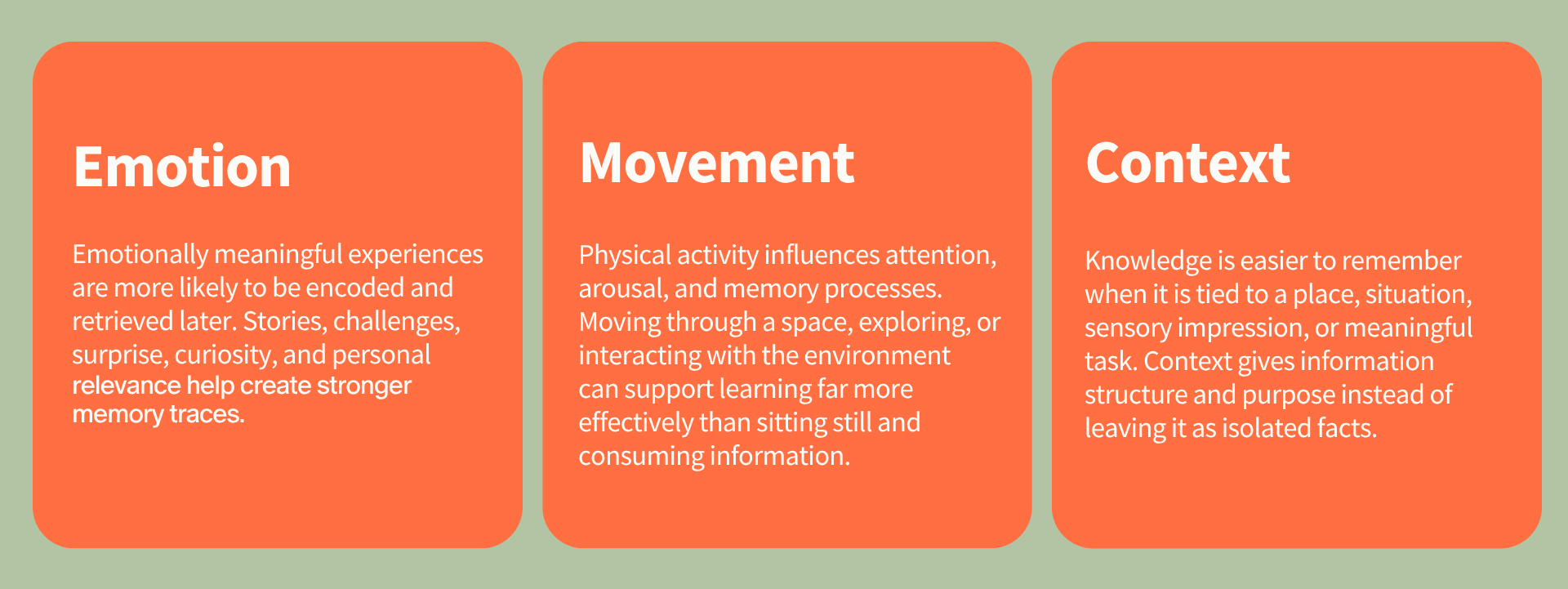
Simply presenting information rarely leads to lasting learning. Retention improves when content is activated, connected to emotions, and embedded in a meaningful context.
Why this matters now
AI is reshaping workplaces and daily life. It can speed up processes, improve access to information, and unlock new creative possibilities. But that makes another question more important: How do we keep our own cognitive abilities active? Attention, problem-solving, creativity, social interaction, and spatial reasoning do not grow through passive consumption. They develop through activity. Brain-based learning treats learning not as information storage, but as a biological process of building and strengthening neural connections. Donald Hebb captured this idea in 1949 with the well-known phrase: “Neurons that fire together, wire together.” In plain English: the brain builds and reinforces connections when we actively do, experience, repeat, and connect things.
Three neurobiological levers for durable learning
Our approach: turn learning into an experience
That is where Actionbound comes in—not as a counterweight to digitalization or AI, but as part of it.
We believe digital technology is most effective when it helps people experience content. So we combine digital information with real-world locations, social interaction, and playful challenges. Information becomes tasks, places become learning spaces, and passive listeners become active participants.
This approach proves useful across many settings:
- Onboarding: New employees explore their workplace independently and experience company culture in context.
- Museums and informal learning environments: Visitors actively engage with stories, perspectives, and exhibits instead of only reading labels.
- Schools and universities: Movement, collaboration, and contextual tasks create learning moments that tend to last longer than lecture-only instruction.
Learning needs activation
The key takeaway is simple: lasting learning requires activity, not passive consumption. The brain wants to discover, connect, and experience ideas. In an age of information overload, success depends less on the sheer amount of data available and more on the instructional quality of the experience. Without deliberate activation, knowledge rarely sticks.